Dairy Cattle Vs Beef Cattle Population

A Holstein cow with prominent udder and less muscle than is typical of beef breeds
Dairy cattle (also called dairy cows) are cattle bred for the ability to produce large quantities of milk, from which dairy products are made. Dairy cattle generally are of the species Bos taurus.[1]
Historically, in that location was niggling distinction between dairy cattle and beefiness cattle, with the same stock often beingness used for both meat and milk production. Today, the bovine industry is more specialized and most dairy cattle have been bred to produce large volumes of milk.
Management [edit]

Cows on a dairy farm in Maryland, U.S.
Dairy cows may be establish either in herds or dairy farms where dairy farmers own, manage, intendance for, and collect milk from them, or on commercial farms. Herd sizes vary around the world depending on landholding culture and social structure. The U.s.a. has an estimated 9 million cows in around 75,000 dairy herds, with an average herd size of 120 cows. The number of small herds is falling rapidly with the 3,100 herds with over 500 cows producing 51% of U.Southward. milk in 2007.[2] The United Kingdom dairy herd overall has nearly 1.five million cows, with near 100 head reported on an boilerplate farm.[three] In New Zealand, the average herd has more than 375 cows, while in Australia, in that location are approximately 220 cows in the average herd.[4] [5]
The United States dairy herd produced 84.two billion kilograms (185.7 billion pounds) of milk in 2007,[vi] upwardly from 52.9 billion kilograms (116.6 billion pounds) in 1950,[7] withal there were only most 9 million cows on U.Southward. dairy farms—about xiii one thousand thousand fewer than at that place were in 1950.[7] The summit brood of dairy moo-cow inside Canada's national herd category is Holstein, taking upwardly 93% of the dairy cow population, have an almanac production charge per unit of x,257 kilograms (22,613 pounds) of milk per cow that contains iii.9% butter fat and 3.2% poly peptide.[8]
Dairy farming, like many other livestock rearing, tin be divide into intensive and extensive management systems.[9]
Intensive systems focus towards maximum production per moo-cow in the herd. This involves formulating their diet to provide platonic nutrition and housing the cows in a solitude system such as free stall or tie stall. These cows are housed indoors throughout their lactation and may exist put to pasture during their lx-day dry period before ideally calving once again. Free stall style barns involve cattle loosely housed where they tin accept free admission to feed, water, and stalls but are moved to another office of the barn to be milked multiple times a mean solar day. In a necktie stall organization, the milking units are brought to the cows during each milking. These cattle are tethered within their stalls with gratuitous access to h2o and feed are provided. In extensive systems, cattle are mainly outside on pasture for virtually of their lives. These cattle are generally lower in milk production and are herded multiple times daily to be milked. The systems used greatly depends on the climate and available country of the region in which the farm is situated.[9]
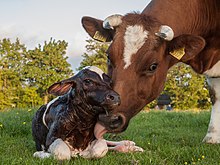
A cow caring for her newborn calf
To maintain lactation, a dairy cow must be bred and produce calves.[10] Depending on market weather, the moo-cow may be bred with a "dairy balderdash" or a "beef balderdash." Female calves (heifers) with dairy breeding may exist kept every bit replacement cows for the dairy herd. If a replacement cow turns out to be a substandard producer of milk, she so goes to market and tin can be slaughtered for beef. Male calves tin either be used later as a breeding balderdash or sold and used for veal or beef. Dairy farmers commonly begin convenance or artificially inseminating heifers around 13 months of age.[eleven] A cow's gestation menstruation is approximately nine months.[12] Newborn calves are separated from their mothers chop-chop, usually within iii days, equally the female parent/calf bond intensifies over fourth dimension and delayed separation tin crusade farthermost stress on both cow and calf.[13]
Domestic cows tin can alive to 13 years; however, those raised for dairy rarely live that long, every bit the average cow is removed from the dairy herd around age six and marketed for beefiness.[12] [14] In 2014, approximately 9.5% of the cattle slaughtered in the U.S. were culled dairy cows: cows that can no longer exist seen as an economic asset to the dairy farm.[xv] These animals may be sold due to reproductive problems or common diseases of milk cows such as mastitis and lameness.[14]
Calf [edit]
Almost heifers (female calves) are kept on subcontract to be raised every bit a replacement heifer, a female person that is bred and enters the product cycle. Market calves are generally sold at two weeks of age and bull calves may fetch a premium over heifers due to their size, either current or potential. Calves may exist sold for veal, or for ane of several types of beef production, depending on available local crops and markets. Such bull calves may be castrated if turnout onto pastures is envisaged, to make them less aggressive. Purebred bulls from aristocracy cows may be put into progeny testing schemes to find out whether they might get superior sires for breeding. Such animals tin become extremely valuable.
About dairy farms separate calves from their mothers within a day of birth to reduce transmission of affliction and simplify management of milking cows. Studies have been washed allowing calves to remain with their mothers for i, four, 7 or 14 days after nascence. Cows whose calves were removed longer than one day after birth showed increased searching, sniffing and vocalizations. Nevertheless, calves immune to remain with their mothers for longer periods showed weight gains at three times the rate of early removals likewise as more searching behavior and better social relationships with other calves.[16] [17]
After separation, some young dairy calves subsist on commercial milk replacer, a feed based on dried milk powder. Milk replacer is an economical culling to feeding whole milk because information technology is cheaper, can be bought at varying fatty and protein percentages, and is typically less contaminated than whole milk when handled properly. Some farms pasteurize and feed calves milk from the cows in the herd instead of using replacer. A solar day-old calf consumes around 5 liters of milk per day.[xviii] [ commendation needed ]
Cattle are social animals; their ancestors tended to live in matriarchal groups of mothers and offspring. The formation of "friendships" between two cows is common and long lasting. Traditionally individual housing systems were used in dogie rearing, to reduce the take chances of illness spread and provide specific care. Withal, due to their social behaviour the grouping of offspring may exist better for the calves' overall welfare. Social interaction between the calves can have a positive effect on their growth. It has been seen that calves housed in grouped penning were institute to eat more feed than those in single pens,[nineteen] suggesting social facilitation of feeding behaviour in the calves. Play behaviour in pre-weaned dairy calves has also been suggested to aid build social skills for later in life. It has been seen that those reared in grouped housing are more likely to become the dominant cattle in a new combination of animals.[20] These dominant animals have a priority choice of feed or lying areas and are generally stronger animals. For these reasons, it has become common practice to group or pair calves in their housing. It has become common in Canada to see paired or grouped housing in outdoor hutches or in an indoor pack penning.[21] [ citation needed ]
Bull [edit]
A bull dogie with high genetic potential may exist reared for breeding purposes. It may be kept past a dairy farm every bit a herd bull, to provide natural breeding for the herd of cows. A balderdash may service up to 50 or threescore cows during a breeding season. Any more and the sperm count declines, leading to cows "returning to service" (needing to be bred over again). A herd bull may only stay for one flavor, equally when most bulls reach over ii years old their temperament becomes too unpredictable.
Bull calves intended for breeding are commonly bred on specialized dairy breeding farms, not production farms. These farms are the major source of stocks for artificial insemination.
Milk production levels [edit]

Dairy cattle in Mangskog, Sweden, 1911.

Dairy Cows, Collins Centre, New York, USA, 1999
The dairy cow produces big amounts of milk in its lifetime. Production levels peak at around 40 to 60 days later calving. Production declines steadily afterwards until milking is stopped at nearly 10 months. The cow is "dried off" for about lx days before calving again. Within a 12 to 14-month inter-calving cycle, the milking period is about 305 days or 10 months long.[22] [23] [24] Amid many variables, certain breeds produce more milk than others within a range of around 6,800 to 17,000 kg (fifteen,000 to 37,500 lb) of milk per year.[25] [ citation needed ]
The Holstein Friesian is the main breed of dairy cattle in Commonwealth of australia, and said to accept the "world'due south highest" productivity, at 10,000 litres (2,200 imp gal; 2,600 US gal) of milk per year.[26] The boilerplate for a single dairy cow in the US in 2007 was 9,164 kg (20,204 lb) per yr, excluding milk consumed past her calves,[6] whereas the aforementioned average value for a single moo-cow in Israel was reported in the Philippine press to be 12,240 kg (26,980 lb) in 2009.[27] High production cows are more difficult to breed at a two-year interval. Many farms have the view that 24 or even 36 month cycles are more appropriate for this blazon of cow.[28] [29]
Dairy cows may continue to exist economically productive for many lactation cycles. In theory a longevity of 10 lactations is possible. The chances of problems arising which may pb to a moo-cow being culled are high, however; the average herd life of Us Holstein is today fewer than 3 lactations. This requires more herd replacements to be reared or purchased. Over 90% of all cows are slaughtered for 4 main reasons:
- Infertility – failure to conceive and reduced milk production.
- Cows are at their most fertile betwixt threescore and 80 days after calving. Cows remaining "open" (non with calf) later on this period become increasingly hard to breed, which may be due to poor health. Failure to expel the afterbirth from a previous pregnancy, luteal cysts, or metritis, an infection of the uterus, are common causes of infertility.
- Mastitis – a persistent and potentially fatal mammary gland infection, leading to high somatic cell counts and loss of production.
- Mastitis is recognized past a reddening and swelling of the infected quarter of the udder and the presence of whitish clots or pus in the milk. Treatment is possible with long-acting antibiotics only milk from such cows is not marketable until drug residues have left the moo-cow'southward organisation, also called withdrawal catamenia.
- Lameness – persistent pes infection or leg problems causing infertility and loss of production.
- High feed levels of highly digestible carbohydrate cause acidic conditions in the cow's rumen. This leads to laminitis and subsequent lameness, leaving the cow vulnerable to other foot infections and issues which may be exacerbated by standing in faeces or water soaked areas.
- Production – some animals neglect to produce economic levels of milk to justify their feed costs.
- Production below 12 to 15 Fifty (2.six to 3.3 imp gal; 3.2 to iv.0 United states of america gal) of milk per twenty-four hours is not economically viable.[30] [ failed verification ] [ citation needed ]
Cow longevity is strongly correlated with production levels.[31] Lower production cows live longer than high production cows, but may exist less assisting. Cows no longer wanted for milk product are sent to slaughter. Their meat is of relatively low value and is generally used for processed meat. Another cistron affecting milk production is the stress the cow is faced with. Psychologists at the University of Leicester, UK, analyzed the musical preference of milk cows and found out that music actually influences the dairy moo-cow's lactation. Calming music can meliorate milk yield, probably because it reduces stress and relaxes the cows in much the same way as it relaxes humans.
Cow comfort and its furnishings on milk production [edit]
Sure behaviors such as eating, ruminating, and lying down can be related to the health of the cow and moo-cow comfort. These behaviors tin as well be related to the productivity of the cows. Likewise, stress, disease, and discomfort negatively touch milk productivity. Therefore, it can exist said that it is in the best involvement of the farmer to increase eating, rumination, and lying down and decrease stress, illness, and discomfort to attain the maximum productivity possible.[32] Also, estrous behaviors such equally mounting can be a sign of cow comfort, since if a moo-cow is lame, nutritionally deficient, or housed in an over crowded befouled, its estrous behaviors is altered.[33]
Feeding behaviors are important for the dairy cow, as feeding is how the cow ingests dry affair. Notwithstanding, the cow must ruminate to fully digest the feed and utilize the nutrients in the feed.[34] Dairy cows with good rumen health are probable to exist more than assisting than cows with poor rumen health—as a salubrious rumen aids in digestion of nutrients. An increase in the time a cow spends ruminating is associated with the increase in health and an increase in milk production.[32] The productivity of dairy cattle is almost efficient when the cattle accept a full rumen.[35] Also, the standing action while feeding after milking has been suggested to raise udder health. The delivery of fresh feed while the cattle are abroad for milking stimulates the cattle to feed upon return, potentially reducing the prevalence of mastitis as the sphincters have fourth dimension to shut while standing.[36] This makes the pattern of feeding straight after existence milked an platonic method of increasing the efficiency of the herd.
Cows have a high motivation to lie downwardly.[34] They should prevarication down for at least 5 to vi hours after every meal to ruminate well.[37] When the lactating dairy cow lies down, blood period is increased to the mammary gland which in return results in a higher milk yield.[38] When they stand also long, cows become stressed, lose weight, get sore feet, and produce less milk.[37]
To ensure that the dairy cows lie downward equally much equally needed, the stalls must be comfortable.[37] A stall should have a condom mat and bedding, and be large plenty for the moo-cow to lie down and get up comfortably. Signs that the stalls may non be comfortable enough for the cows are the cows are standing, either ruminating or not, instead of lying down, or perching, which is when the cow has its front end terminate in the stall and their back end out of the stall.[39] Dried manure, almond shells, straw, sand, or waterbeds are used for cow bedding.[37]
There are ii types of housing systems in dairy production, free manner housing and tie stall. Gratuitous manner housing is where the cow is free to walk around and interact with its surroundings and other members of the herd. Tie stall housing is when the cow is chained to a stantion stall with the milking units and feed coming to them.[40]
By-products and processing [edit]
Pasteurization is the procedure of heating milk to a loftier enough temperature for a short menstruum of time to kill the microbes in the milk and increment proceed time and decrease spoilage time. By killing the microbes, decreasing the transmission of infection, and elimination of enzymes the quality of the milk and the shelf life increases. Pasteurization is either completed at 63 °C (145 °F) for xxx minutes or a flash pasteurization is completed for fifteen seconds at 72 °C (162 °F).[41] By-products of milk include butterfat, cream, curds, and whey. Butterfat is the primary lipid in milk. The cream contains 18–twoscore% butterfat. The industry tin can be divided into 2 market territories; fluid milk and industrialized milk such as yogurt, cheeses, and ice cream.[42]
Whey poly peptide makes upward almost twenty% of milk's protein limerick and is separated from the casein (80% of milk's protein brand upwardly) during the process of curdling cheese. This protein is commonly used in protein bars, beverages and full-bodied powder, due to its high quality amino acrid profile. It contains levels of both essential amino acids as well as branched that are above those of soy, meat, and wheat.[43] "Diafiltered" milk is a process of ultrafiltration of the fluid milk to split up lactose and water from the casein and whey proteins. This process allows for more efficiency in cheese making and gives the potential to produce depression-carb dairy products.[44]
Reproduction [edit]
Since the 1950s, artificial insemination (AI) is used at most dairy farms; these farms may go on no bull. Artificial insemination uses rut synchronization to betoken when the cow is going through ovulation and is susceptible to fertilization. Advantages of using AI include its depression toll and ease compared to maintaining a bull, ability to select from a large number of bulls, elimination of diseases in the dairy industry, improved genetics and improved animal welfare.[45] [ citation needed ] Rather than a large bull jumping on a smaller heifer or weaker cow, AI allows the farmer to consummate the convenance procedure within v minutes with minimum stress placed on the individual female'south trunk.[46] [ citation needed ]
Dairy cattle are polyestrous, meaning they bike continuously throughout the year. They tend to exist on a 21 day estrus cycle. However for management purposes, some operations apply synthetic hormones to synchronize their cows or heifers to have them brood and calve at the ideal times. These hormones are brusque term and only used when necessary. For example, one common protocol for synchronization involves an injection of GnRH (gonadotrophin releasing hormone). which increases the levels of follicle stimulating hormone and luteinizing hormone in the body. Then, seven days afterwards prostaglandin F2-alpha is injected, followed by another GnRH injection 48 hours later on. This protocol causes the animate being to ovulate 24 hours later.[47]
Estrus is oftentimes called standing estrus in cattle and refers to the time in their cycle where the female person is receptive towards the male. Estrus behaviour tin be detected by an experienced stockman. These behaviours can include continuing to exist mounted, mounting other cows, restlessness, decreased milk production, and decreased feed intake.[48]
More recently, embryo transfer has been used to enable the multiplication of progeny from elite cows. Such cows are given hormone treatments to produce multiple embryos. These are then 'flushed' from the cow'due south uterus. 7–12 embryos are consequently removed from these donor cows and transferred into other cows who serve every bit surrogate mothers. This results in between three and half dozen calves instead of the normal single or (rarely) twins.
Hormone employ [edit]
Farmers in some countries sometimes administer hormone treatments to dairy cows to increment milk production and reproduction.
Virtually 17% of dairy cows in the United States are injected with Bovine somatotropin, likewise called recombinant bovine somatotropin (rBST), recombinant bovine growth hormone (rBGH), or bogus growth hormone.[49] The use of this hormone increases milk production by 11%–25%.[ citation needed ] The U.Southward. Food and Drug Administration (FDA) has ruled that rBST is harmless to people.[ citation needed ] The utilise of rBST is banned in Canada, parts of the European Union, as well as Australia and New Zealand.[ citation needed ]
In the United States the Pasteurized Milk Ordinance requires a milk sample is taken from every farm and from every load of milk delivered to a processing establish.[l] These samples are and then tested for antibiotic and whatsoever milk testing positive is discarded and farm identified. Traceback to the dairy is undertaken past the FDA with further consequences including the possibility revocation of ability to sell milk.[51]
Nutrition [edit]
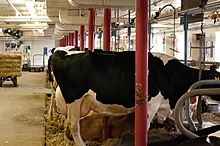
Dairy cattle at feeding time
Nutrition plays an of import office in keeping cattle healthy and strong. Implementing an adequate nutrition program can also improve milk product and reproductive functioning. Nutrient requirements may not be the same depending on the animal's age and stage of production. Diets are formulated to meet the dairy cow'due south free energy and amino acid requirements for lactation, growth, and/or reproduction.[52]
Forages, which refer particularly to anything grown in the field such as hay, straw, corn silage, or grass silage, are the near common type of feed used. The base of nearly lactating dairy cattle diets is loftier quality forage. Cereal grains, every bit the chief contributors of starch to diets, are of import in helping to meet the energy needs of dairy cattle. Barley is an first-class source of balanced amounts of protein, energy, and fiber.[53]
Ensuring adequate torso fatty reserves is essential for cattle to produce milk and besides to keep reproductive efficiency. However, if cattle get excessively fatty or as well sparse, they run the risk of developing metabolic issues and may have problems with calving.[54] Scientists have found that a diversity of fat supplements tin benefit conception rates of lactating dairy cows. Some of these different fats include oleic acids, found in canola oil, animal tallow, and yellow grease; palmitic acid found in granular fats and dry fats; and linolenic acids which are found in cottonseed, safflower, sunflower, and soybean.[55]
Using by-products is one way of reducing the usually high feed costs. However, lack of knowledge of their nutritional and economic value limits their employ. Although the reduction of costs may be pregnant, they have to be used carefully because animal may have negative reactions to radical changes in feeds, (e.grand. fog fever). Such a change must then exist fabricated slowly and with the proper follow upwardly.[56]
Breeds [edit]

According to the Purebred Dairy Cattle Clan, PDCA, there are seven major dairy breeds in the United states. These are: Holstein, Chocolate-brown Swiss, Guernsey, Ayrshire, Jersey, Red and White, and Milking Shorthorn.[57]
Holstein cows originate from holland and have distinct blackness and white or more rarely ruby and white markings. Holstein cows are the biggest of all dairy breeds. A total mature Holstein cow commonly weighs around 700 kilograms (1,500 lb) and is 147 centimetres (58 in) tall at the shoulder. They are known for their outstanding milk production amongst the master breeds of dairy cattle. An boilerplate Holstein cow produces around 10,000 kilograms (23,000 lb) of milk each lactation. Of the 9 million dairy cows in the U.South., approximately 90% of them are of the Holstein descent.[58] The tiptop brood of dairy cow within Canada's national herd category is Holstein, taking up 93% of the dairy moo-cow population, accept a production rate of 10,257 kilograms (22,613 lb) of milk per cow that contains 3.9% butter fatty and 3.2% protein[viii]
Brown Swiss cows are widely accepted as the oldest dairy cattle breed, originally coming from a role of northeastern Switzerland. Some experts think that the modernistic Brownish Swiss skeleton is similar to one found that looks to exist from effectually the year 4000 BC Also, there is show that monks started breeding these cows about m years ago.[59]
The Ayrshire brood beginning originated in the County of Ayr in Scotland. It became regarded every bit a well established breed in 1812. The unlike breeds that were crossed to form the Ayrshire are not exactly known. However, at that place is evidence that several breeds were crossed with the native cattle to create the breed.[60]
Guernsey cows originated just off the declension of France on the small Island of Guernsey. The breed was showtime known as a separate breed around 1700. Guernseys are known for their power to produce very high quality milk from grass. Also, the term "Golden Guernsey" is very common as Guernsey cattle produce rich, xanthous milk rather than the standard white milk other cow breeds produce.[61]
The Bailiwick of jersey breed of dairy cow originated on a small island located off the coast of France called Jersey.[62] Despite being one of the oldest breeds of dairy cattle they now but occupy 4% of the Canadian National Herd.[63] Purebred Bailiwick of jersey cows, according to available data, have been in the UK area since about the year 1741. When they were offset bred in this surface area, they were non known as Jerseys, but rather as the related Alderneys. The catamenia between 1860 and around 1914 was a popular time for Jerseys. In this fourth dimension span, many countries other than the United States started importing this breed, including Canada, Southward Africa, and New Zealand, among others.[64]
Among the smallest of the dairy breeds, the boilerplate Jersey moo-cow matures at approximately 410 kilograms (900 lb), with a typical weight range between 360 and 540 kilograms (800–1,200 lb). Co-ordinate to Due north Dakota State Academy, the fatty content of the Jersey cow's milk is 4.9 percent. Information technology is likewise the highest in poly peptide, at 3.8 percent.[65] This high fat content means the milk is often used for making water ice cream and cheeses. Co-ordinate to the American Bailiwick of jersey Cattle Association, Jerseys are found on 20 percentage of all United states of america dairy farms and are the primary breed in about four percent of dairies.[66] [ citation needed ]
Amongst the Bos indicus, the most popular dairy breed in the globe is Sahiwal of the Indian subcontinent. It does non requite as much milk as the Taurine breeds, but it is past far the most suitable breed for warmer climates. Australian Friesian Sahiwal and Australian Milking Zebu have been developed in Australia using Sahiwal genetics. Gir, another of the Bos indicus breeds, has been improved in Brazil for its milk product and is widely used there for dairy.
Animal welfare [edit]
Animal welfare refers to both the physical and mental country of an animal, and how it is coping with its state of affairs. An animal is considered in a practiced state of welfare if it is able to express its innate behaviour, comfortable, salubrious, safe, well nourished, and is not suffering from harmful states such as distress, fright and pain. Good animal welfare requires disease prevention and veterinary handling, appropriate shelter, direction, nutrition, and humane handling. If the beast is slaughtered then it is no longer "good animal welfare".[67] Information technology is the human responsibleness of the animals' wellbeing in all husbandry and direction practices including humane euthanasia.
Proper brute treatment, or stockmanship, is crucial to dairy animals' welfare as well as the safety of their handlers. Improper treatment techniques tin can stress cattle leading to impaired product and health, such as increased slipping injuries. Additionally, the majority of nonfatal worker injuries on a dairy subcontract are from interactions with cattle. Dairy animals are handled on a daily basis for a broad variety of purposes including health-related management practices and movement from freestalls to the milking parlor. Due to the prevalence of human being-animal interactions on dairy farms, researchers, veterinarians, and farmers alike have focused on furthering our understanding of stockmanship and educating agriculture workers. Stockmanship is a complex concept that involves the timing, positioning, speed, direction of move, and sounds and touch of the handler.[68] [ citation needed ]
A recent survey of Minnesota dairy farms revealed that 42.6% of workers learned stockmanship techniques from family members, and 29.9% had participated in stockmanship training. However, equally the growing U.Due south. dairy industry increasingly relies on an immigrant workforce, stockmanship training and instruction resources become more pertinent. Clearly communicating and managing a large culturally diverse workforce brings new challenges such every bit language barriers and time limitations.[69] Organizations similar the Upper Midwest Agriculture Safety and Wellness Middle offer resources such as bilingual grooming videos, fact sheets, and informational posters for dairy worker preparation. Additionally the Beef Quality Balls Programme offer seminars, live demonstrations, and online resource for stockmanship training.[70] [ commendation needed ]
For cows to reach high operation in milk yields and reproduction, they must be in keen condition and comfortable in the system. Once an individual's welfare is reduced, and so does her efficiency and production. This creates more toll and time on the functioning, therefore most farmers strive to create a good for you, hygienic, atmosphere for their cattle. As well equally provide quality nutrition that keep the cows yield high.[71]
The production of milk requires that the moo-cow be in lactation, which is a result of the cow having given birth to a calf. The cycle of insemination, pregnancy, parturition, and lactation is followed past a "dry out" period of nigh two months earlier calving, which allows udder tissue to regenerate. A dry period that falls exterior this time frames can result in decreased milk production in subsequent lactation.[72] Dairy operations therefore include both the production of milk and the production of calves. Bull calves are either castrated and raised as steers for beefiness product or used for veal.
The practice of dairy product has been criticized past animal rights proponents. Some of the ethical reasons regarding dairy production cited include how often the dairy cattle are impregnated, the separation of calves from their mothers, the fact that dairy cows are considered "spent" and culled at a relatively young age, as well as ecology concerns regarding any cattle production.[73]
Meet likewise [edit]
- Listing of Dairy cattle breeds
- Estrous synchronization
- Fog fever
- Dairy cattle showmanship
- Meat industry
References [edit]
- ^ "Mammals of Wisconsin". Archived from the original on 9 June 2011. Retrieved 29 March 2012.
- ^ MacDonald, James M.; O'Donoghue, Erik J.; McBride, William D.; Nehring, Richard F.; Sandretto, Carmen L.; Mosheim, Roberto (4 September 2007). Profits, Costs, and the Changing Structure of Dairy Farming (Report). United states Department of Agriculture. Economic Research Service. Economical Research Report Number 47. Archived (PDF) from the original on 6 November 2020. Retrieved v November 2020.
- ^ "Milk and Milk Products, Great britain Dairy Industry Archived 15 Jan 2011 at the Wayback Car," Department for Surroundings Nutrient and Rural Affairs 3 September 2010.
- ^ "New Zealand Dairy Statistics 2009–2010 Archived 24 July 2011 at the Wayback Machine," Dairy NZ 2010.
- ^ "Industry Statistics Archived 20 May 2011 at the Wayback Automobile," Dairy Australia. Retrieved 5 January 2011.
- ^ a b U.Southward. Department of Agriculture, National Agriculture Statistics Service (March 2009). "Milk Cows and Production Estimates 2003–2007" (PDF) . Retrieved thirty January 2011. .
- ^ a b Blaney, Don P. (June 2002). "The Changing Landscape of U.S. Milk Production" (PDF). Statistical Bulletin Number 978, U.S. Department of Agriculture. Archived from the original (PDF) on viii March 2013. Retrieved 30 January 2011.
- ^ a b Centre, Government of Canada;Canadian Dairy Information. "Dairy Animate being Registrations – Canadian Dairy Data Center (CDIC)". www.dairyinfo.gc.ca . Retrieved 29 January 2018.
- ^ a b Passetti; et al. (December 2016). "Intensive dairy farming systems from Kingdom of the netherlands and Brazil" (PDF). Acta Scientiarum.
- ^ "About dairy cows". www.ciwf.com . Retrieved six August 2019.
- ^ Department of Brute Scientific discipline," Cattle Teaching and Inquiry Heart Archived 16 May 2011 at the Wayback Automobile," Michigan Land Academy 4 Nov 2010.
- ^ a b Dewey, T. and J. Ng., "Bos taurus," Animal Diversity Web, 2001. Retrieved 13 January 2011.
- ^ Dale More et al., "Calf Housing and Environments Serial," Veterinarian Medicine Extension Dec. 2010. Archived 1 September 2011 at the Wayback Car
- ^ a b Wallace, Richard Fifty. (13 March 2002). "Market Cows: A Potential Turn a profit Center". University of Illinois Extension. Retrieved xxx Jan 2011.
- ^ U.South. Department of Agriculture, National Agriculture Statistics Service (April 2015). "Livestock Slaughter Annual Summary" (PDF). Archived from the original (PDF) on 12 September 2015. Retrieved 24 November 2015.
- ^ Flower, Frances C; Weary, Daniel M (January 2001). "Effects of early separation on the dairy moo-cow and dogie". Practical Animal Behaviour Scientific discipline. 70 (4): 275–284. doi:10.1016/s0168-1591(00)00164-vii. PMID 11179551.
- ^ Stěhulová, Ilona; Lidfors, Lena; Špinka, Marek (March 2008). "Response of dairy cows and calves to early on separation: Effect of dogie age and visual and auditory contact after separation". Applied Animate being Behaviour Science. 110 (1–2): 144–165. doi:10.1016/j.applanim.2007.03.028.
- ^ "Feeding the Newborn Dairy Dogie". Penn Land Extension . Retrieved 23 May 2021.
- ^ Overvest, Morgan (July 2015). Outcome of feeding strategy and social housing on behaviour at weaning in dairy calves (Thesis). hdl:10214/9194.
- ^ Duve, L.R.; Weary, D.M.; Halekoh, U.; Jensen, M.B. (November 2012). "The furnishings of social contact and milk assart on responses to treatment, play, and social beliefs in immature dairy calves". Journal of Dairy Scientific discipline. 95 (eleven): 6571–6581. doi:10.3168/jds.2011-5170. PMID 22939785.
- ^ "Lawmaking of Practise for the Care and Handling of Beef Cattle". www.nfacc.ca . Retrieved 23 May 2021.
- ^ Hutjens, Mike (24 Feb 1999). "Managing the Transition Cow". University of Illinois Extension. Retrieved 30 January 2011.
- ^ "Life Bike and Lactation Wheel of Dairy Cows: Life Bike of Typical Milk Producing Dairy Moo-cow". VET IN Training – Veterinary Disease Data Blog . Retrieved 25 Apr 2017.
- ^ Moran, John (18 May 2015). "Managing Moo-cow Lactation Cycles". The Cattle Site . Retrieved 25 April 2017.
- ^ "What Causes a Cow to Cease Producing Milk / 8 Videos - Farm Beast Written report". world wide web.farmanimalreport.com . Retrieved 22 May 2021.
- ^ 'Holstein' (AUSTREX website). Accessed 30 Oct 2016.
- ^ "12,000 liters milk per moo-cow!, 2009". Archived from the original on half dozen Feb 2012.
- ^ "Genetic characterization of indigenous cattle breeds in Republic of zambia - which way frontward? - Stories, NAFA". www-naweb.iaea.org . Retrieved 22 May 2021.
- ^ "Farm structures ... - Ch10 Animate being housing: Cattle housing". www.fao.org . Retrieved 22 May 2021.
- ^ PubChem. "Benzene". pubchem.ncbi.nlm.nih.gov . Retrieved 22 May 2021.
- ^ Knaus, Wilhelm (May 2009). "Dairy cows trapped between performance demands and adaptability". Journal of the Scientific discipline of Nutrient and Agriculture. 89 (vii): 1107–1114. doi:ten.1002/jsfa.3575.
- ^ a b Vanhoudt, Arne; van Winden, Steven; Fishwick, John C.; Bell, Nicholas J. (December 2015). "Monitoring cow condolement and rumen health indices in a cubicle-housed herd with an automatic milking arrangement: a repeated measures approach". Irish Veterinary Journal. 68 (1): 12. doi:10.1186/s13620-015-0040-7. PMC4465732. PMID 26075057.
- ^ O'Connor, Michael 50 (17 May 2016). "Heat Detection and Timing of Insemination for Cattle".
- ^ a b Cooper, K.D.; Arney, D.R.; Phillips, C.J.C. (March 2007). "Two- or Four-Hour Lying Deprivation on the Behavior of Lactating Dairy Cows". Journal of Dairy Science. 90 (three): 1149–1158. doi:ten.3168/jds.S0022-0302(07)71601-six. PMID 17297089.
- ^ Lindström, Tina; Redbo, Ingrid (December 2000). "Upshot of feeding elapsing and rumen fill on behaviour in dairy cows". Practical Animate being Behaviour Scientific discipline. 70 (2): 83–97. doi:10.1016/s0168-1591(00)00148-ix. PMID 11080553.
- ^ DeVries, T.J.; von Keyserlingk, Yard.A.G. (February 2005). "Fourth dimension of Feed Delivery Affects the Feeding and Lying Patterns of Dairy Cows". Journal of Dairy Science. 88 (two): 625–631. doi:x.3168/jds.S0022-0302(05)72726-0. PMID 15653529.
- ^ a b c d Tweti, Mira (26 October 2002). "Water Beds for Cattle? These Cows Milk Information technology for All It's Worth". Los Angeles Times . Retrieved 26 May 2021.
- ^ Haley, D.B; de Passillé, A.K; Rushen, J (February 2001). "Assessing moo-cow comfort: effects of 2 floor types and two tie stall designs on the behaviour of lactating dairy cows". Applied Animal Behaviour Science. 71 (2): 105–117. doi:x.1016/s0168-1591(00)00175-1. PMID 11179563.
- ^ Anderson, 2014. Dairy Cow Condolement – Gratis-stall Dimensions.
- ^ Heart, Regime of Canada;Canadian Dairy Information. "Types of Dairy Barns – Canadian Dairy Information Centre (CDIC)". dairyinfo.gc.ca . Retrieved 29 January 2018.
- ^ "Milk Microbiology | MilkFacts.info".
- ^ Center, Government of Canada;Canadian Dairy Information. "Dairy Facts and Figures – Canadian Dairy Information Heart (CDIC)". dairyinfo.gc.ca . Retrieved 29 January 2018.
- ^ Gangurde, HemantH; Patil, PoojaS; Chordiya, MayurA; Baste, NayanaS (2011). "Whey protein". Scholars' Research Periodical. i (2): 69. doi:10.4103/2249-5975.99663.
- ^ "FAQs| DPAC-ATLC". Dairy Processors Clan of Canada . Retrieved three April 2018.
- ^ "Artificial Insemination - an overview | ScienceDirect Topics". www.sciencedirect.com . Retrieved 22 May 2021.
- ^ "Livestock:: Cattle:: Artificial InseminationAnimal Husbandry :: Home". agritech.tnau.air conditioning.in . Retrieved 22 May 2021.
- ^ "Oestrus Synchronization of Dairy Cattle" (PDF) . Retrieved 28 March 2018.
- ^ "Estrus Detection and Timing of Insemination for Cattle". Penn State Extension.
- ^ "Dairy 2007 Role 2: Changes in the U.South. Dairy Cattle Industry, 1991–2007" (PDF). Fauna and Found Health Inspection Service. March 2007. Archived from the original (PDF) on 13 January 2010. Retrieved 27 January 2010.
- ^ https://www.fda.gov/media/114169/download[ bare URL PDF ]
- ^ Nutrition, Center for Food Safety and Applied (8 Apr 2020). "National Drug Residue Milk Monitoring Program". FDA.
- ^ "Formulating dairy cow rations". extension.umn.edu.
- ^ "Feeding Barley to Dairy Cattle". Retrieved 2 June 2010.
- ^ "Feeding Dairy Cattle for Proper Body Condition Score". Retrieved 2 June 2010.
- ^ "Fats Divers". Retrieved two June 2010.
- ^ "By-Products and Regionally Bachelor Alternative Feedstuffs for Dairy Cattle". Retrieved 2 June 2010.
- ^ "Purebred Dairy Cattle Association". Purebred Dairy Cattle Association. Purebred Dairy Cattle Association. Retrieved 17 September 2014.
- ^ "Facts about Holstein Cattle" (PDF). Holstein Association USA Inc.
- ^ "Breeds – Brown Swiss". The Cattle Site . Retrieved 9 February 2016.
- ^ "Breeds – Ayrshire". The Cattle Site . Retrieved nine February 2016.
- ^ "Breeds – Guernsey". The Cattle Site . Retrieved 9 February 2016.
- ^ "Breeds of Livestock – Jersey Cattle — Breeds of Livestock, Department of Animate being Science". www.ansi.okstate.edu . Retrieved 29 January 2018.
- ^ Eye, Government of Canada;Canadian Dairy Information. "Boilerplate Milk Production by Breed (Milk Recording) – Canadian Dairy Data Centre (CDIC)". dairyinfo.gc.ca . Retrieved 29 Jan 2018.
- ^ "Breeds – Jersey". The Cattle Site . Retrieved nine February 2016.
- ^ "Cows With the Highest Milk Fat Content". Pets on Mom.com.
- ^ "Cows With the Highest Milk Fat Content". Pets on Mom.com . Retrieved 22 May 2021.
- ^ Moran, John; Doyle, Rebecca (2015). Cow Talk. CSIRO Publishing. ISBN9781486301614.
- ^ Bearding. "Dairy Cattle direction I Mshindo media". Retrieved 23 May 2021.
- ^ Sorge, U.S.; Cherry-red, C.; Bender, J.B. (July 2014). "Perception of the importance of homo-brute interactions on cattle menses and worker safety on Minnesota dairy farms". Journal of Dairy Science. 97 (7): 4632–4638. doi:10.3168/jds.2014-7971. PMID 24835968.
- ^ "Beef Quality Assurance - BQA - Online Certifications". Beefiness Quality Assurance - BQA . Retrieved 22 May 2021.
- ^ Fregonesi, Jose A; Leaver, J.David (March 2001). "Behaviour, performance and wellness indicators of welfare for dairy cows housed in strawyard or cubicle systems". Livestock Production Science. 68 (two–iii): 205–216. doi:x.1016/S0301-6226(00)00234-7.
- ^ Bachman, K.C.; Schairer, M.Fifty. (October 2003). "Invited Review: Bovine Studies on Optimal Lengths of Dry Periods". Journal of Dairy Science. 86 (10): 3027–3037. doi:10.3168/jds.S0022-0302(03)73902-2. PMID 14594219.
- ^ Doggett, Tyler (2018), "Moral Vegetarianism", in Zalta, Edward Due north. (ed.), The Stanford Encyclopedia of Philosophy (Fall 2018 ed.), Metaphysics Research Lab, Stanford University, retrieved 22 May 2021
brewsterhatte1962.blogspot.com
Source: https://en.wikipedia.org/wiki/Dairy_cattle
0 Response to "Dairy Cattle Vs Beef Cattle Population"
Post a Comment